Ammonia Marine Propulsion: Key Safety and Compliance Challenges
Why is ammonia marine propulsion attracting so much attention now?
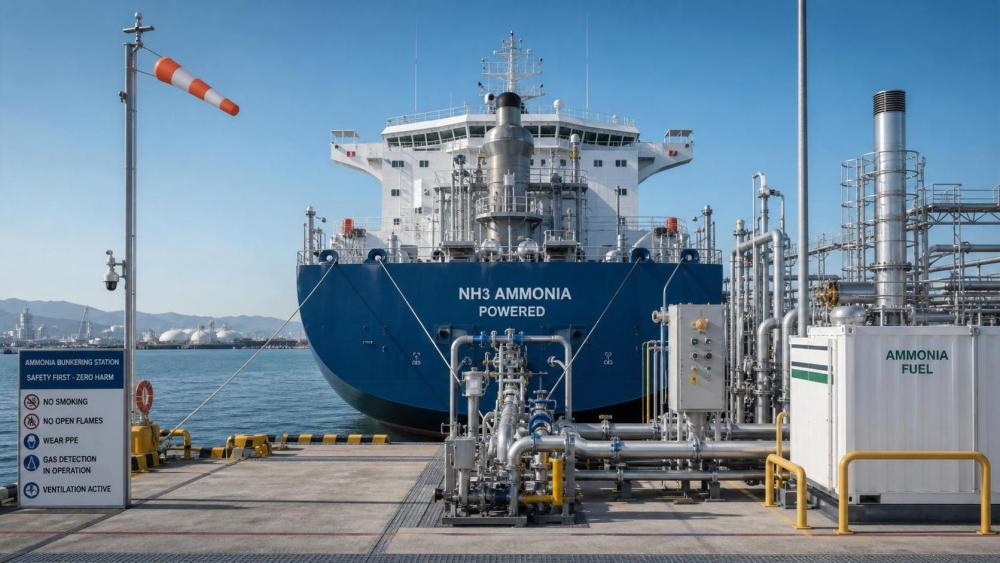
Ammonia marine propulsion has moved from concept studies to serious project screening.
The reason is simple.
Shipping needs lower-carbon fuel pathways that can support deep-sea operations, not just short demonstration routes.
Ammonia does not contain carbon at the point of use, which makes it highly relevant to decarbonization planning.
That does not mean ammonia marine propulsion is automatically a safe or ready solution.
In practice, the biggest hesitation is not only engine maturity.
It is the combined burden of toxicity management, leak response, fuel containment, crew procedures, and compliance evidence.
This is why the topic now sits beside LNG, methanol, CII strategy, and IMO compliance in technical reviews across commercial vessels and offshore assets.
On information platforms such as MOES, ammonia marine propulsion is rarely discussed in isolation.
It is usually evaluated together with propulsion efficiency, tank arrangement, shipyard feasibility, class approval, and lifecycle operating risk.
That broader view matters, because an ammonia project can look promising on emissions math yet still fail a practical safety review.
What makes ammonia marine propulsion more difficult than other alternative fuels?
The short answer is toxicity changes everything.
Methanol is flammable. LNG adds cryogenic and gas hazards. Ammonia introduces a severe human exposure risk even at relatively low concentrations.
That affects equipment design, ventilation philosophy, sensor placement, escape routes, and emergency drills.
It also changes how non-routine work is controlled.
Hot work nearby, maintenance isolation, bunkering preparation, and enclosed-space response all need tighter procedural barriers.
Another challenge is that ammonia marine propulsion is still developing across the supply chain.
Engines, fuel systems, transfer components, detection packages, and crew competency frameworks are not yet as standardized as conventional fuel systems.
As a result, safety reviews cannot rely only on legacy ship checklists.
They need design-specific hazard identification and strong interface control between yard, equipment vendor, class, and operator.
A useful way to frame the issue is to separate fuel promise from operational readiness.
If these basics are still vague, the project is not yet mature enough for confident approval.
Which safety risks deserve the earliest attention?
Many discussions start with emissions, but the first screening should focus on exposure pathways.
Where can ammonia escape, accumulate, or travel after a release?
That question is more useful than a generic hazard list.
The main risk clusters are usually predictable.
- Fuel storage and piping integrity, including flange points, seals, and instrument connections
- Ventilation performance in machinery spaces, fuel preparation rooms, and bunkering interfaces
- Gas detection coverage, alarm voting, and false-alarm management
- Emergency shutdown logic that is fast, understandable, and tested
- Personal protective equipment that matches credible release scenarios
- Decontamination, first aid, and evacuation routes that work under poor visibility and stress
A common mistake is to treat ammonia marine propulsion as mainly an engine-room engineering topic.
In reality, it is a whole-vessel safety case.
The tank arrangement affects cargo deck operations.
The bunkering concept affects port interface risk.
The ventilation design affects crew survivability.
For offshore support vessels and units with complex machinery layouts, those interactions become even more important.
A sound review often asks one practical question.
If a small release happens during a busy operation, do alarms, people, barriers, and procedures actually work together?
How do class rules and IMO-aligned requirements shape project approval?
There is no shortcut here.
Ammonia marine propulsion must be reviewed through class requirements, flag expectations, port considerations, and company safety management systems.
Because ammonia is still an emerging marine fuel, projects often depend on risk-based approval routes rather than mature prescriptive pathways.
That means more documentation, more justification, and more design iteration.
Typical evidence packages include hazard identification studies, HAZOP outputs, gas dispersion analysis, fire and explosion review, bunkering studies, and emergency response logic.
The aim is not paperwork for its own sake.
The aim is to demonstrate that the ammonia marine propulsion arrangement reaches an equivalent or better safety level than conventional practice.
In practical terms, compliance teams usually need to track several moving parts at once.
- Which class society guidance applies to fuel containment, piping, ventilation, and control systems
- How IMO decarbonization targets interact with technical safety obligations
- Whether local port or terminal rules affect bunkering windows and emergency readiness
- How vessel procedures align with ISM documentation and drill records
This is where MOES-style cross-disciplinary intelligence becomes useful.
A compliance decision on ammonia marine propulsion often depends on engineering details, commercial route profile, and port interface constraints at the same time.
Is crew training the weak point, or is system design the bigger issue?
It is usually a false choice.
Poor design cannot be saved by training, and good design can still fail with weak operational discipline.
For ammonia marine propulsion, the safest projects build training into the design review from the start.
That means alarm thresholds are understandable, isolation points are accessible, procedures are short enough to use, and drills reflect realistic timing.
A useful benchmark is whether a new crew member can identify the immediate actions for three situations.
A detector alarm in a machinery space.
A suspected bunkering hose issue.
A crew exposure incident requiring first response and area control.
If the response depends on searching a long manual, readiness is weak.
In actual audits, training evidence is strongest when it combines competence matrices, scenario-based drills, maintenance lockout practice, and post-drill corrective actions.
That approach also supports insurers, charter review, and internal management confidence.
What should be checked before choosing ammonia marine propulsion for a vessel or offshore project?
The decision should not start with fuel trend headlines.
It should start with vessel duty, route conditions, bunkering access, machinery arrangement, and regulatory exposure.
Some projects are structurally better suited to ammonia marine propulsion than others.
A long-haul ship with strategic decarbonization pressure may justify the complexity sooner than a vessel with uncertain fuel supply access.
The same logic applies offshore, where space, redundancy, and emergency response constraints can alter the safety case significantly.
Before a final technology choice, it helps to review five decision points together.
This kind of review keeps ammonia marine propulsion from being judged only by ambition or only by fear.
It puts the decision back into a measurable maritime framework.
So what is the sensible next step if ammonia remains under consideration?
A sensible next step is not to ask whether ammonia marine propulsion is good or bad in general.
The better question is whether a specific vessel or offshore concept can control the safety and compliance burden credibly.
Start with a gap review.
Map the intended operating profile, expected bunkering pattern, preliminary hazardous areas, emergency philosophy, and approval milestones.
Then test that map against realistic release scenarios, not ideal assumptions.
If the project still looks robust, move into deeper engineering and competency planning.
If key answers remain uncertain, that is also valuable.
It shows where further design work, supplier clarification, or route-specific analysis is required.
Ammonia marine propulsion may become a major part of low-carbon shipping.
But safe adoption will depend less on headline momentum and more on disciplined engineering, auditable procedures, and compliance-ready execution.
That is the standard worth applying before any final commitment.
Related News
- How air lubrication changes container ship design and fuel savingsSep 15, 2026Marine Thermodynamics Expert
- When does a crane anti-sway retrofit improve container handling safety?Sep 14, 2026Terminal Kinematics Strategist
- What to verify before choosing a marine communication equipment supplier in NorwaySep 13, 2026Maritime Telemetry Fellow
- What drives marine engine retrofits cost on older vessels?Sep 12, 2026Marine Thermodynamics Expert
- How offshore structural engineering design manages fatigue in FPSO hullsSep 11, 2026Offshore Structural Scientist
- How to compare an automated guided vehicles manufacturer for port useSep 10, 2026Terminal Kinematics Strategist