
EU CBAM Extends to Shipping Services in 2027
On January 1, 2027, the EU’s carbon border adjustment mechanism is set to expand into international shipping services under the implementation roadmap released by the European Commission on June 15, 2026. The change matters not only because it adds a carbon-related compliance layer to service activities carried out at EU ports, but also because it reaches practical operating links such as ship repair, LNG bunkering, ballast water treatment, and desulfurization services. For Chinese shipyards, environmental equipment suppliers, and port service providers serving the EU market, the issue is no longer limited to technical delivery alone; carbon reporting, certification status, and cost allocation may become part of contracting and execution.
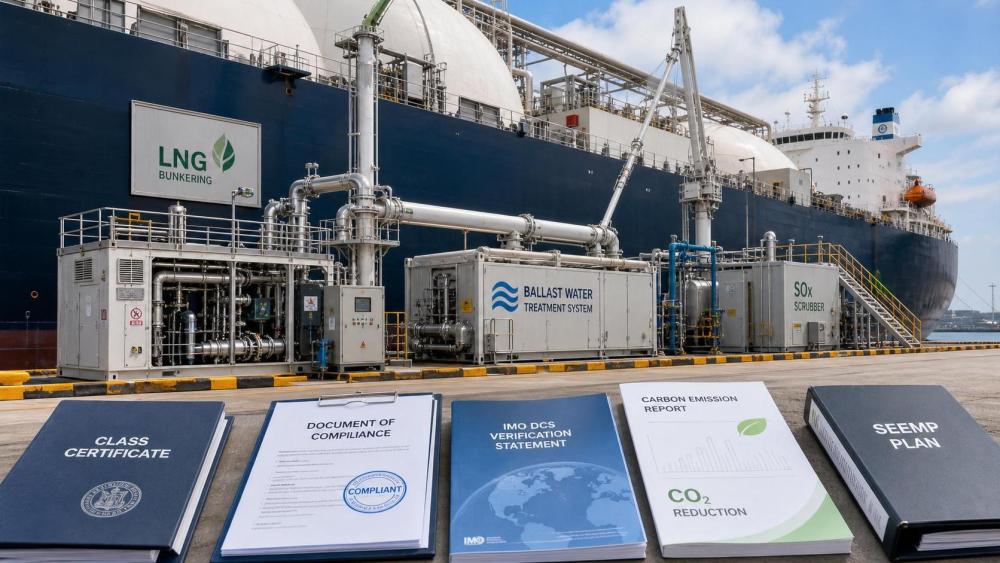
What the roadmap clearly puts in scope
According to the information provided, the European Commission issued the EU Shipping CBAM Implementation Roadmap on June 15, 2026, and stated that CBAM will cover international shipping services from January 1, 2027.
The covered scope includes third-party service links taking place at EU ports, including ship repair, LNG bunkering, ballast water treatment, and desulfurization services.
The provided information also states that when Chinese shipyards, environmental equipment suppliers, and port service providers supply these services to the EU, they will need to submit full-lifecycle carbon emissions reports certified under EU-MRV, and they may also bear a staged carbon cost-sharing arrangement.
Where the pressure may appear across the service chain
Service providers tied directly to EU port operations
From an industry perspective, the most direct impact may fall on companies that provide the covered service activities at EU ports. The reason is straightforward: the rule change is linked to the service event itself, not only to upstream manufacturing. In practice, affected businesses may need to pay closer attention to whether carbon reporting materials, EU-MRV-certified documentation, and contract language are ready before service delivery begins.
Shipyards and technical contractors with cross-border delivery obligations
For shipyards and technical contractors, the change may affect more than invoicing or customs-facing procedures. Analysis shows that service quotations, project scheduling, subcontracting arrangements, and handover documentation could all be influenced if carbon reporting becomes a precondition for acceptance or settlement in EU-linked projects. What deserves closer attention is whether lifecycle emissions evidence can be assembled in a form that matches customer or port-side compliance expectations.
Environmental equipment suppliers and related support vendors
Suppliers involved in desulfurization, ballast water treatment, or other covered support services may face indirect pressure through procurement and vendor qualification. Even where the supplier is not the final service operator, buyers may begin asking for more detailed emissions-related records, technical files, or certification support to reduce downstream compliance uncertainty.
Port service coordinators and commercial counterparties
Companies managing service coordination, tendering, or procurement for port-based operations may also need to adjust. Observably, the change could affect how responsibilities are divided in contracts, especially where staged carbon cost-sharing is involved. Commercial teams may need to review how service scope, reporting obligations, and carbon-related cost terms are defined before work is awarded.
What companies should watch before execution practices settle
Readiness of EU-MRV-related reporting materials
Analysis shows that the immediate practical issue is not only whether a company is covered, but whether it can prepare full-lifecycle emissions reporting in a form accepted under EU-MRV certification requirements. Businesses involved in the listed service categories may need to review internal data collection, supplier inputs, and document consistency.
Contract wording and cost allocation mechanisms
The provided information mentions possible staged carbon cost-sharing, but does not define how that mechanism will be applied in each transaction. It is therefore more appropriate to understand this as an area requiring close review rather than a settled operating rule. Companies may need to monitor how customers, tenders, and counterparties begin to reflect carbon cost allocation in service contracts.
Procurement and subcontractor qualification checks
Where delivery depends on multiple vendors or technical subcontractors, companies may need to pay more attention to whether supporting parties can provide the necessary emissions records and certification-linked documents. This is especially relevant for projects in which technical completion alone may no longer be sufficient for smooth acceptance.
Changes in bid files, delivery packages, and compliance review
Observably, one of the first visible market responses may appear in tender documents, prequalification materials, and delivery checklists. Even without detailed execution rules in the input, companies should watch for changes in document requirements, reporting formats, and compliance review language connected with EU port-based service work.
Why this looks like an execution signal, not just a policy headline
Analysis shows that this development is better understood as a rule extension with operational consequences rather than as a general climate-policy headline. The reason is that the information provided already connects the policy change to specific service categories, a defined start date, and a concrete reporting requirement tied to EU-MRV-certified lifecycle emissions data.
At the same time, it is also appropriate to treat this as a developing compliance framework rather than a fully settled operating regime. Key execution details, market interpretation, and contract-level implementation will still need continued observation. For industry participants, the practical question is less whether the policy exists and more how quickly it begins to reshape documentation, pricing, and supplier screening in EU-related shipping services.
How this update is best understood for now
At this stage, the development points to a clear expansion of carbon compliance from goods-focused trade logic into service activities connected with shipping operations at EU ports. For affected companies, the significance lies in the likely integration of emissions reporting, certification readiness, and carbon cost discussion into routine commercial and delivery processes.
A neutral reading is that this is already a meaningful compliance signal, while many execution details still deserve verification through later official clarification, market practice, and contract implementation. In other words, it is more appropriate to understand the update as both an announced rule change and an area that requires ongoing monitoring.
Basis of this article and points that still need verification
This article is generated based on the user-provided news title, event date, and event summary. The specific official source link was not provided in the input, so it still needs to be verified on an ongoing basis.
For this type of development, commonly relevant source categories may include official announcements, releases by regulatory authorities, customs or trade administration information, industry association updates, standards-related documents, and reporting by authoritative media. Further attention is still needed on detailed implementation rules, certification interpretation, tender document changes, market feedback, and how affected companies ultimately carry out compliance in practice.
Related News
- How air lubrication changes container ship design and fuel savingsSep 15, 2026Marine Thermodynamics Expert
- When does a crane anti-sway retrofit improve container handling safety?Sep 14, 2026Terminal Kinematics Strategist
- What to verify before choosing a marine communication equipment supplier in NorwaySep 13, 2026Maritime Telemetry Fellow
- What drives marine engine retrofits cost on older vessels?Sep 12, 2026Marine Thermodynamics Expert
- How offshore structural engineering design manages fatigue in FPSO hullsSep 11, 2026Offshore Structural Scientist
- How to compare an automated guided vehicles manufacturer for port useSep 10, 2026Terminal Kinematics Strategist