
Singapore MPA Adds Air Lubrication BWT Test
On July 5, 2026, the Maritime and Port Authority of Singapore (MPA) updated its technical notice on import re-testing for Ballast Water Management Systems, introducing an added verification requirement for systems seeking MPA type approval. From September 1, 2026, applicants must submit evidence of biological inactivation performance when BWT systems operate together with Air Lubrication Systems, including testing tied to flow-field disturbance and coordinated UV or electrolysis decay. For BWT manufacturers, integrators, exporters, certification workstreams, and procurement teams, this is a compliance change worth close attention because it may affect approval timing and system design decisions linked to export business.
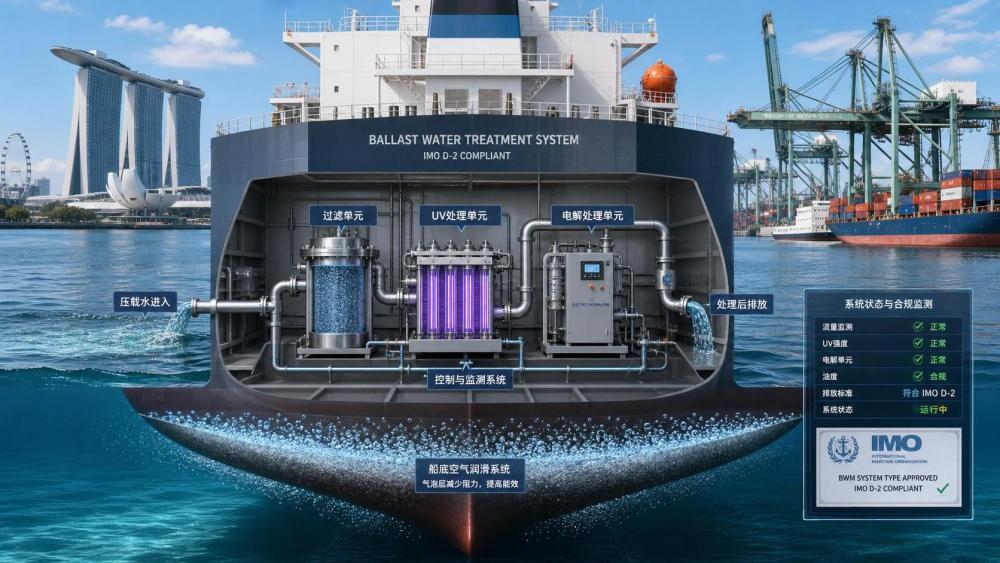
What the updated MPA notice changes
The confirmed change is limited but specific. MPA updated its technical notice for import re-testing of Ballast Water Management Systems on July 5, 2026. Under the updated requirement, any BWT system applying for MPA type approval from September 1, 2026 must provide an additional validation report showing biological inactivation performance under joint operation with Air Lubrication Systems.
The required validation scope expressly includes flow-field disturbance as well as coordinated attenuation testing involving UV or electrolysis. The information provided also indicates that this update is expected to affect the certification cycle and system integration design of Chinese BWT manufacturers exporting to ports in Southeast Asia and the Middle East.
Where the pressure is likely to appear first
Approval planning now extends beyond the standalone BWT unit
From an industry perspective, manufacturers and exporters seeking MPA type approval are the first group likely to feel the change. The added submission requirement means compliance review is no longer limited to the ballast water treatment function in isolation. The business impact may appear in certification scheduling, test preparation, technical file completeness, and the coordination of supporting evidence before market entry or shipment planning.
System integration teams face a narrower documentation margin
For engineering and integration teams, the rule change points to a more detailed review of how BWT systems perform when operated together with Air Lubrication Systems. What deserves closer attention is that the requirement is tied not only to equipment presence, but to demonstrated inactivation performance under combined operating conditions. This may affect specification alignment, design review, and the technical basis used in bid documents, product configurations, or customer submissions.
Testing and certification support functions may see additional workload
Certification-related service providers and testing support organizations may also be affected because the added validation item increases the importance of test scope definition, report structure, and document readiness. The practical issue is not only whether a report exists, but whether the report clearly addresses the verification points identified in the updated notice. For exporters and project delivery teams, document timing may become a more sensitive factor in approval and handover planning.
Practical points companies should track now
Review existing approval pipelines against the September 1 deadline
Analysis shows that companies with pending or planned MPA type approval applications should first map their current project pipeline against the September 1, 2026 implementation date. Where application timing is tight, the added verification item may become a gating document rather than a routine supplement.
Check whether technical files fully address combined-operation validation
Companies should examine whether current technical documentation already covers operation alongside Air Lubrication Systems, especially where product configurations are marketed for integrated vessel solutions. If the existing file set does not clearly address flow-field disturbance and coordinated UV or electrolysis attenuation under combined operation, the gap may affect submission readiness.
Align procurement and delivery assumptions with compliance lead time
For procurement, sales, and delivery teams, a key issue is whether contract schedules, bid assumptions, and delivery commitments still reflect the updated approval path. Observably, even without detailed execution guidance in the input, the added requirement is enough to justify a review of supplier qualification materials, testing deliverables, and documentation lead time in export projects linked to MPA recognition.
Watch for changes in tender language and customer documentation requests
Because the update relates directly to type approval evidence, companies should monitor whether customers, shipyards, or project counterparties begin to request expanded validation language in tenders, technical clarifications, or pre-delivery document lists. The input does not confirm how fast such downstream adjustments will occur, so this remains an area to watch rather than a settled outcome.
Why this reads as an execution signal
Analysis shows that this development is more appropriately understood as an execution-oriented compliance signal than as a general policy statement. The rule change is tied to a defined effective date and a specific approval document requirement, which gives it immediate practical relevance for companies preparing submissions. At the same time, the available information does not yet establish how strictly different review scenarios will be interpreted in practice, so market participants still need to watch for detailed implementation patterns.
From an industry perspective, the most important takeaway is that combined-operation performance is being brought more clearly into the approval conversation. That matters less as a headline and more as a sign that technical interaction between shipboard systems may receive closer regulatory attention in certification workflows.
How the market should read this update
The current update should be read as a concrete compliance change with direct implications for certification preparation and system integration planning, especially for Chinese BWT manufacturers serving export markets connected to Southeast Asia and the Middle East. It would be premature to treat it as proof of broader market outcomes, but it is already relevant as a near-term requirement that can influence application timing, document preparation, and project coordination.
What deserves closer attention is not only the added test item itself, but how quickly it begins to shape approval expectations, tender wording, and delivery planning across related export business. At this stage, a measured reading is most appropriate: the rule has moved beyond abstract discussion, while parts of its downstream execution still warrant continued observation.
Basis of this article and points still requiring verification
This article is based on the user-provided news title, event date, and event summary. It has been written from the supplied information that MPA updated its technical notice on import re-testing for Ballast Water Management Systems on July 5, 2026, and that from September 1, 2026, applicants for MPA type approval must provide an added validation report covering biological inactivation performance during joint operation with Air Lubrication Systems, including flow-field disturbance and coordinated UV or electrolysis decay testing.
For this type of regulatory development, relevant source categories typically include official notices, releases by regulatory authorities, trade or customs authorities, industry association updates, standard-setting documents, and reporting by established sector media. No specific official source link was provided in the input, so the exact official link still needs to be verified. It remains necessary to continue monitoring detailed implementation language, certification review practice, tender-document changes, industry feedback, and how companies incorporate the requirement into actual export and delivery workflows.
Related News
- How air lubrication changes container ship design and fuel savingsSep 15, 2026Marine Thermodynamics Expert
- When does a crane anti-sway retrofit improve container handling safety?Sep 14, 2026Terminal Kinematics Strategist
- What to verify before choosing a marine communication equipment supplier in NorwaySep 13, 2026Maritime Telemetry Fellow
- What drives marine engine retrofits cost on older vessels?Sep 12, 2026Marine Thermodynamics Expert
- How offshore structural engineering design manages fatigue in FPSO hullsSep 11, 2026Offshore Structural Scientist
- How to compare an automated guided vehicles manufacturer for port useSep 10, 2026Terminal Kinematics Strategist