
China Adds 55% Tariff on Australian Beef
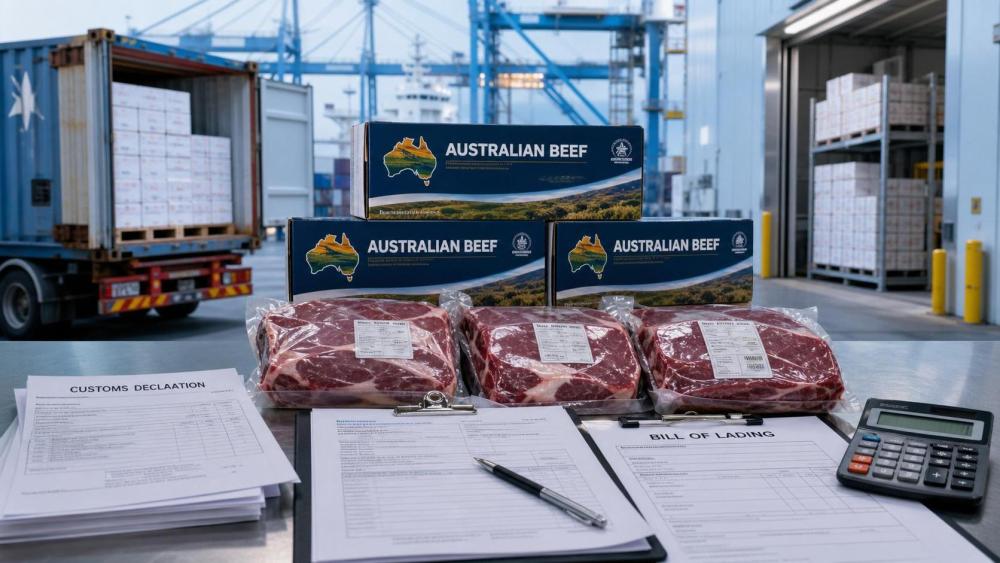
China will impose an additional 55% safeguard tariff on imported Australian beef from 00:00 on June 20, 2026, on top of the existing tariff rate. The move matters well beyond bilateral trade: it affects red meat sourcing, landed-cost calculations, and customs compliance for distributors, importers, and supply chain operators that rely on Australian premium beef, particularly across Southeast Asia, the Middle East, and Latin America.
What Has Been Confirmed So Far
According to the information provided, the tariff measure takes effect on June 20, 2026. China’s Ministry of Commerce stated that an additional 55% safeguard tariff will apply to Australian beef imports on top of the current tariff basis. The stated trigger is that Australia’s beef exports to China have already reached 100% of the annual quota ceiling, activating an automatic mechanism under the safeguard rules.
Where the Pressure May Appear in the Supply Chain
Import cost exposure becomes more immediate
From an industry perspective, companies directly involved in beef trade may face the most immediate impact because the policy changes the duty burden at the point of import. What deserves closer attention is how this affects product pricing, quotation validity, and shipment timing for cargo linked to Australian-origin beef.
Procurement teams may need to reassess sourcing plans
Analysis shows that businesses buying Australian premium beef are likely to focus on procurement budgets and replacement options. The main pressure point is not only higher acquisition cost, but also whether existing sourcing plans, customer commitments, and delivery assumptions still hold under the new tariff treatment.
Distributors and channel operators face compliance and pass-through questions
Observably, distributors in Southeast Asia, the Middle East, and Latin America are especially relevant in this development because the provided information highlights their reliance on Australian premium beef. Their concerns may center on landed cost pass-through, customs declaration accuracy, and how origin-related documentation aligns with actual transaction flows.
Supply chain service providers may see more document scrutiny
For logistics, customs, and trade-compliance service providers, the issue is likely to shift toward declaration pathways and supporting documentation. From an industry perspective, any business handling import processing or cross-border red meat trade should pay closer attention to whether tariff application, origin claims, and transaction records remain fully aligned.
What Companies Should Watch Now
Track any further official clarification
Analysis shows that companies should distinguish between the confirmed headline measure and any later operational clarification. The effective time, the additional tariff level, and the quota-trigger explanation are confirmed in the provided information, but practical implementation details may still require ongoing verification through subsequent official language.
Review products, contracts, and shipment timing
Businesses exposed to Australian beef should closely examine which product lines, orders, and in-transit arrangements may be affected from June 20 onward. What deserves closer attention is whether pricing terms, delivery schedules, and customer commitments were built on pre-measure assumptions.
Recheck compliance documents and declaration logic
For importers, distributors, and service providers, this is not only a procurement issue but also a documentation issue. Observably, origin paperwork, customs declarations, and supporting trade records become more important when tariff treatment changes and compliance pathways attract greater scrutiny.
Prepare customer and supplier communication in advance
From an industry perspective, companies should be ready to explain the difference between the policy signal and the practical business impact. Supplier coordination, cost discussions, and client communication may need to start before affected shipments or contract cycles reach the implementation date.
Why This Looks Like More Than a Short-Term Pricing Issue
Analysis shows that this development is better understood as both an immediate trade-cost change and a broader supply-chain signal. The confirmed trigger is quota-related and automatic in nature, which means the current event is not only about a single price adjustment but also about how businesses interpret quota thresholds, safeguard activation, and sourcing concentration risk. At the same time, it is still appropriate to treat parts of the downstream impact as an evolving industry dynamic rather than a fully settled outcome, because actual responses across procurement, logistics, and distribution will depend on how market participants adjust.
How to Read the Industry Meaning at This Stage
At this stage, the clearest takeaway is that the tariff change creates a confirmed cost and compliance event for Australian beef entering China from June 20, 2026. A more cautious interpretation is that the wider market impact should still be observed through the behavior of traders, buyers, and distribution networks. It is more appropriate to understand this as a concrete near-term policy change with wider supply-chain implications that warrant continued monitoring, rather than as a final judgment on long-term market reordering.
Basis of This Article and What Still Needs Verification
This article is based on the user-provided news title, event date, and event summary. For developments of this type, relevant source categories usually include official government notices, company disclosures, industry association updates, authoritative media reporting, and trade or standards-related documents. No specific official source link was provided in the input, so the exact source document link still needs to be verified on an ongoing basis. Continued attention should focus on any further official clarification, implementation wording, and practical compliance requirements affecting procurement and customs handling.
Related News
- How air lubrication changes container ship design and fuel savingsSep 15, 2026Marine Thermodynamics Expert
- When does a crane anti-sway retrofit improve container handling safety?Sep 14, 2026Terminal Kinematics Strategist
- What to verify before choosing a marine communication equipment supplier in NorwaySep 13, 2026Maritime Telemetry Fellow
- What drives marine engine retrofits cost on older vessels?Sep 12, 2026Marine Thermodynamics Expert
- How offshore structural engineering design manages fatigue in FPSO hullsSep 11, 2026Offshore Structural Scientist
- How to compare an automated guided vehicles manufacturer for port useSep 10, 2026Terminal Kinematics Strategist