DNV Approves First Commercial LEO Maritime Terminal
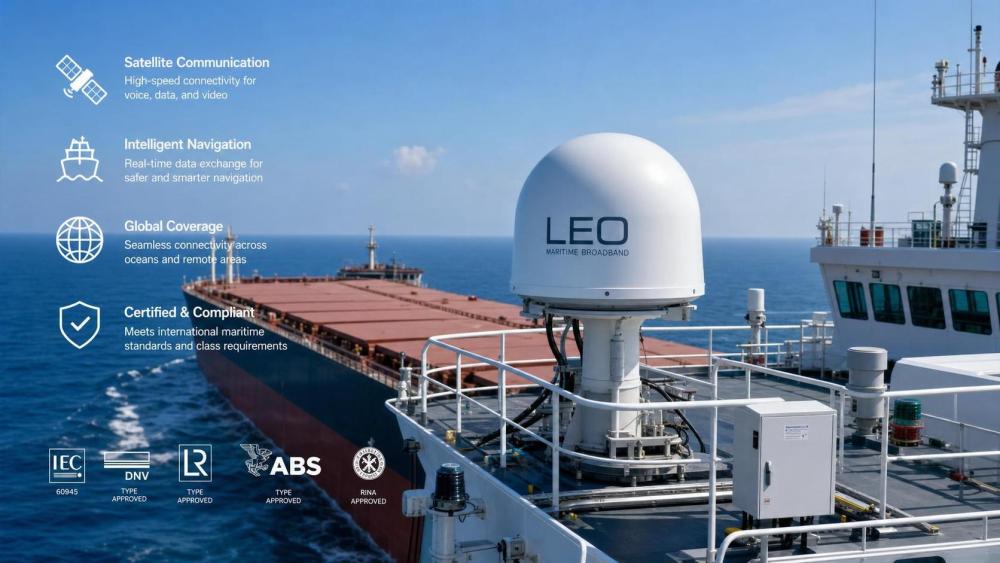
The timing of the underlying operational deployment is not clearly specified in the available information, but the certification milestone is clear: on June 23, 2026, DNV issued a type approval certificate for what is described as the world’s first shipborne commercial maritime broadband terminal based on the Starlink Gen2+ LEO constellation. For shipowners, bridge-system suppliers, navigation technology developers, and procurement teams serving high-end merchant vessels in Europe and North America, this development deserves attention because it links satellite connectivity, onboard navigation support, and compliance access in a single certification pathway.
What the certification confirms
According to the provided information, DNV formally issued type approval certificate No. MAR-LEO-2026-0881 on June 23, 2026. The certificate covers a shipborne maritime broadband terminal based on the Starlink Gen2+ LEO constellation and is identified as the first commercial approval of its kind.
The core AI-assisted navigation coordination module integrated into the terminal was developed by a Shenzhen-based company. The same information states that this module has passed both ECDIS compatibility verification and STCW-AI assisted decision-support verification.
The certification is described as opening a key compliance route for Chinese intelligent navigation equipment to enter the supporting supply chain for high-end merchant vessels in the European and North American markets.
Where the industry may feel the impact first
Shipboard equipment sourcing may shift toward compliance-led screening
From an industry perspective, shipowners, ship managers, and purchasing teams may be affected first because type approval directly shapes whether a product can be considered in vessel equipment selection. The main impact is likely to appear in specification review, approved vendor evaluation, and discussions around bridge-system integration. What deserves closer attention is whether buyers begin treating this kind of approval as a baseline requirement for LEO-enabled maritime broadband terminals with AI-supported navigation functions.
Bridge and navigation system integrators face a tighter interoperability focus
Analysis shows that system integrators and bridge equipment providers may need to pay closer attention to how broadband connectivity hardware, ECDIS-related compatibility, and AI-assisted decision support are documented and validated together. The business impact is less about a single product launch and more about whether integration packages can meet customer expectations for both operational functionality and certification readiness.
Chinese intelligent navigation suppliers gain a clearer entry route
Observably, the most direct signal for Chinese developers and manufacturers is not simply market visibility, but a more defined compliance path into higher-end merchant vessel supply chains in Europe and North America. The affected business links may include product qualification, overseas customer communication, tender participation, and supporting technical documentation.
Service and support providers may need to prepare for more cross-functional requests
Suppliers involved in delivery, after-sales support, and certification coordination may also see practical effects. If more buyers evaluate similar solutions, service teams may need to respond to questions that combine connectivity performance, navigation workflow compatibility, crew-use implications, and certification scope rather than handling them as separate topics.
What companies should watch next
Track how certification language is used in procurement discussions
Analysis shows that companies should distinguish between a certification milestone and immediate large-scale commercial adoption. The practical issue is how shipowners, yards, integrators, and overseas buyers refer to this approval in tenders, vendor shortlists, and technical clarifications.
Review documentation around integration, not just standalone product claims
What deserves closer attention is the integrated nature of the approval. Companies working on adjacent equipment or software may need to prepare clearer materials on compatibility, interface responsibilities, and onboard deployment boundaries, especially where AI-assisted functions interact with established navigation systems.
Prepare for customer scrutiny on verification scope
For sales, compliance, and project teams, one immediate task is to communicate accurately what has been verified: the available information mentions ECDIS compatibility and STCW-AI assisted decision-support verification. Firms should avoid extending those points into broader claims that are not covered by the stated facts.
Align supply-chain readiness with compliance timing
Observably, if this approval becomes a reference point for future sourcing, suppliers may need to review qualification files, delivery schedules, technical support readiness, and customer response materials. The commercial opportunity, where it appears, is likely to depend as much on document completeness and certification coordination as on the hardware or software itself.
Why this looks more like a strategic signal than a finished market outcome
Analysis shows that this development is best read as an important compliance and market-access signal rather than proof of immediate, broad-based market conversion. The confirmed facts point to a breakthrough in type approval and integrated verification, but they do not by themselves establish shipment scale, fleet-wide adoption, or broader procurement trends.
From an industry perspective, the significance lies in the combination of three elements: LEO maritime broadband, AI-supported navigation coordination, and acceptance within a recognized classification framework. That combination suggests a clearer route for future commercial discussion, but it still requires continued observation to determine how widely shipowners and system buyers will act on it.
How to read this development now
At this stage, it is more appropriate to understand the news as a concrete compliance milestone with potential supply-chain implications. It confirms that a Chinese-developed AI navigation module has been integrated into a DNV-approved commercial LEO maritime terminal and that the approval may ease entry into higher-end overseas vessel supply chains. It does not yet confirm how quickly this will translate into broader deployment or repeat approvals across comparable products.
Basis of this article
This article is based on the user-provided news title, event timing description, and event summary. The specific official source link was not provided in the input, so the underlying details still need continued verification against materials such as official notices, company statements, classification society publications, industry association updates, authoritative media coverage, and relevant standards-related documents where available.
Key follow-up areas to watch include whether additional official wording is released around the certificate scope, whether similar approvals appear for related maritime connectivity and navigation products, and how procurement and integration requirements evolve in response to this certification milestone.
Related News
- How air lubrication changes container ship design and fuel savingsSep 15, 2026Marine Thermodynamics Expert
- When does a crane anti-sway retrofit improve container handling safety?Sep 14, 2026Terminal Kinematics Strategist
- What to verify before choosing a marine communication equipment supplier in NorwaySep 13, 2026Maritime Telemetry Fellow
- What drives marine engine retrofits cost on older vessels?Sep 12, 2026Marine Thermodynamics Expert
- How offshore structural engineering design manages fatigue in FPSO hullsSep 11, 2026Offshore Structural Scientist
- How to compare an automated guided vehicles manufacturer for port useSep 10, 2026Terminal Kinematics Strategist