
China’s PCTC order rises to 41 ships, export demand drives fleet procurement
Around July 15, 2026, global PCC/PCTC/RoCon new shipbuilding orders increased rapidly, and the market has confirmed 39 ships. If Bahri’s two ship options are finally implemented, it will reach 41 ships. Judging from the disclosed data that China's automobile exports reached 5.096 million units in the first half of the year, including 2.355 million new energy vehicles, this change is more suitable to be understood as a procurement signal under the joint action of trade flow, ship type configuration and IMO compliance requirements, which may affect the delivery rhythm of ship owners' ship bookings, equipment suppliers' production scheduling, compatible ship type modifications, and compliance system integration.
The increased volume of automobile exports has pushed the demand for professional shipping capacity to the forefront
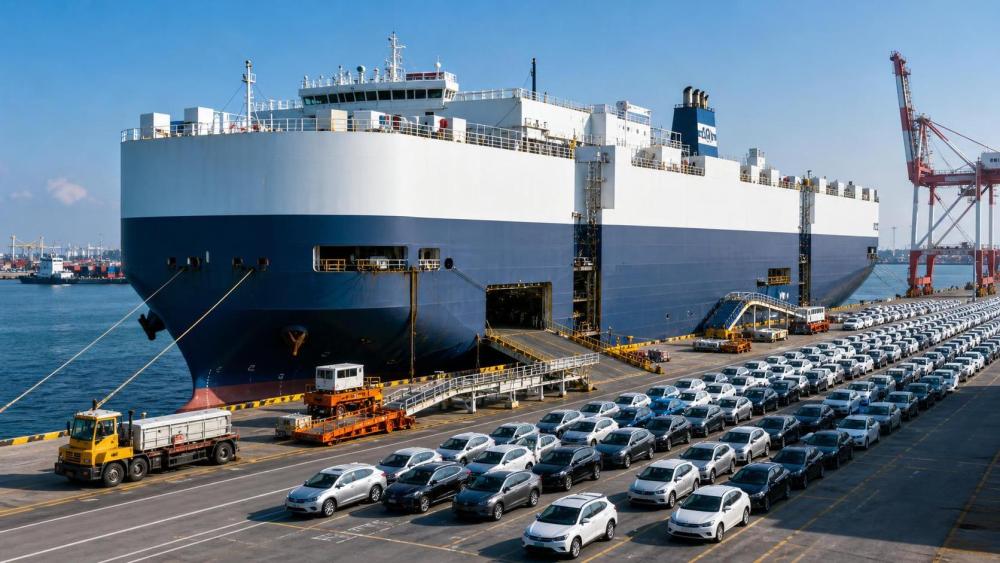
Confirmed information shows that global PCC/PCTC/RoCon new shipbuilding orders will reach 39 ships in mid-July 2026. If Bahri’s two ship options are implemented, it will increase to 41 ships, which is significantly higher than the 9 ships in 2025. At the same time, China's automobile exports reached 5.096 million units in the first half of the year, a year-on-year increase of 65.3%, including 2.355 million new energy vehicles. Viewed together, the two sets of data reflect not the popularity of a single ship type, but the expansion of the scale of vehicles to be transported, which is releasing the need for centralized procurement of professional car carriers and compatible ship types.
Ship owner procurement pays more attention to ship type compatibility and delivery matching
For international ship owners, such order changes will first be transmitted to ship type selection and delivery arrangements. The procurement decisions of PCTC, RoCon and multi-purpose ships not only look at the transport capacity itself, but also pay more attention to loading compatibility, route adaptability and subsequent modification space. The growth in confirmed orders means that shipowners need to more closely balance delivery windows and operational arrangements between newbuildings, option executions and existing ship conversions.
Equipment suppliers will be pulled into an earlier production scheduling rhythm
For ship equipment suppliers, increased orders usually lead to more intensive export production scheduling and delivery coordination. What deserves more attention now is that equipment selection, supply cycle and shipyard integration interface may enter the procurement negotiation stage earlier. Since the information has clearly mentioned the cooperation window of IMO compliance system integrators, this means that the relevant system is not an accessory link, but one of the prerequisites for entering the order decision-making chain.
The importance of compliance and modification links is rising
For companies responsible for modification, testing, certification and system integration, the impact of this change is mainly reflected in compliance review and delivery connection. Professional car carriers and compatible ship types often need to match loading, safety, emissions and related IMO requirements. The subsequent specific enforcement standards will directly affect the modification plan, document preparation and acceptance cycle. Observation shows that the market focus has shifted from “is there demand” to “how to deliver according to the rules”.
After the order is placed, which aspects should companies look at first?
Check certification and technical documents first.
For companies involved in procurement and modification, certification and compliance review should be put first. What needs to be checked is not the abstract rules, but whether the technical documents, test reports, equipment lists and system interface information corresponding to the project are consistent with the bidding or procurement requirements. For projects involving IMO compliance systems, whether the relevant documents are complete and the versions are consistent will often directly affect subsequent progress.
Another look at delivery times and supplier qualifications
Increased orders often compress the buffer time between negotiation and delivery. Enterprises need to pay more attention to whether supplier qualifications, production capacity arrangements and delivery commitments can correspond to the actual shipping schedule. For equipment, modification and system integration links, if the procurement plan is not aligned with the shipyard nodes, subsequent delays will easily occur during the installation, commissioning and acceptance stages.
Trade and after-sales terms must be put on paper in advance
If the business involves export trade or cross-border procurement, documents, warranty, after-sales response and responsibility boundaries need to be clearly stated at the contract stage. In the current context of growing demand, quality traceability and fault response arrangements are most easily overlooked. For relevant companies, whether delivery responsibilities, spare parts support and follow-up maintenance can be written into procurement documents directly determines the stability of project enforcement.
This is more like an execution signal than the final conclusion
From an industry perspective, this information is currently more suitable to be understood as a clear execution signal: shipowners have begun to concentrate their purchases on professional car carriers and compatible ship types, and the increase in export traffic is rewriting the logic of transport capacity allocation. But it is not the final conclusion, because the input information does not provide specific policy details, official enforcement standards or final contract conditions. The follow-up still depends on whether the order option is implemented, how the modification project is executed, and how IMO compliance requirements are reflected in specific projects.
More importantly, market feedback will tell the story better than a single order number. If subsequent bidding documents, certification requirements, equipment specifications, and delivery nodes continue to tighten, this means that rule-level constraints are being brought forward in actual procurement; if these conditions do not change significantly, this wave of orders should be understood as a phased procurement adjustment brought about by the release of transportation demand, rather than immediately extrapolated to a long-term fixed trend.
Conclusions that should be paid more attention to in the short term
Taken together, this information reflects the process of automobile export driving the simultaneous upward movement of professional capacity procurement, modification demand and compliance integration. For shipowners, equipment suppliers, modification companies and compliance service providers, the most realistic task at present is not to judge the popularity, but to check whether the rules, documents and delivery chain can keep up with the pace of orders. It is more suitable to be understood as a market execution signal that has already appeared. At the same time, it is still necessary to continue to observe the enforcement of specific orders and the refinement of rules.
The scope of public information this article is based on
This article is generated based on the information title, event time and event summary provided by the user. Types of sources typically associated with such events include official announcements, regulatory agency releases, customs or trade authority information, industry association information, standards organization documents, and authoritative media reports. Since no specific official source link is provided in the input, and relevant links are not listed in this article, it is still necessary to continue to verify policy details, certification enforcement standards, changes in bidding documents, industry feedback, and actual enforcement by enterprises.
Related News
- What determines cargo capacity on PCTC vessels?Sep 26, 2026Naval Hydrodynamics Architect
- When turret mooring systems make sense for an FPSO in harsh watersSep 25, 2026Offshore Structural Scientist
- When do terminal automation solutions reduce container yard costs?Sep 24, 2026Ms. Vivienne Cross
- How Transpacific vessel weather routing reduces heavy-weather exposureSep 23, 2026Maritime Telemetry Fellow
- When does marine fuel transition investment pay back for shipowners?Sep 21, 2026Dr. Elias Vance
- When AI terminal operating systems improve container terminal throughputSep 20, 2026Terminal Kinematics Strategist